Entrepreneur
The Psychology of a Founder: Top 10 Mindset Shifts to Think Like an Entrepreneur

Success in business is not just about having money or a good product. It starts with how you use your brain. To build a great company, you must learn how to think like an entrepreneur. This means changing how you see the world, how you handle problems, and how you make decisions every day.
Being an entrepreneur is a mindset. You do not need to own a huge factory to think this way. Whether you are starting a small side job or working at a big company, thinking like a founder helps you grow. In this guide, we will look at the steps to change your thinking and build a successful future.
Top 10 Mindset Shifts to Think Like an Entrepreneur
1. Developing a Growth Mindset for Business
The first step is understanding that you can always learn more. This is called a growth mindset. People with a "fixed" mindset believe they are born with a certain amount of skill and cannot change. Entrepreneurs believe the opposite. They know that with hard work and time, they can learn any new skill.
In business, things change fast. New technology arrives, and old ways of working stop being useful. If you have a growth mindset, you do not fear these changes. Instead, you see them as a chance to get better. You read books, talk to experts, and practice until you master a new topic. This hunger for knowledge is what keeps a business alive.
You may also read :- Entrepreneur vs Employee Mindset: Key Differences Explained
2. Thinking Like a Founder vs. Employee

There is a big difference between thinking like a founder vs. an employee. An employee often waits for instructions. They do their specific job and go home. They want safety and a steady paycheck.
A founder, or someone with an entrepreneurial mind, looks at the "big picture." They don't just ask, "What is my task?" They ask, "How can I make this whole company better?" Founders take ownership. If something is broken, they don't wait for someone else to fix it. They take the lead. They care about the result, not just the hours they spend working.
3. View Problems as Opportunities
Most people hate problems. They see a mistake or a hurdle and feel frustrated. An entrepreneur sees a problem and gets excited. Why? Because every problem is a chance to create a solution that people might pay for.
Think about the biggest companies today. They all started by solving a problem.
- Uber solved the problem of finding a taxi.
- Airbnb solved the problem of expensive hotels.
- Amazon solved the problem of having to drive to many stores to find one item.
When you face a "pain point" in your life, stop complaining. Instead, ask: "How can I fix this for myself and others?" This is the core of opportunity recognition frameworks. You are training your eyes to see gaps in the market that others miss.
4. Embrace Calculated Risk & Uncertainty
You cannot be an entrepreneur if you want 100% safety. Business involves many unknowns. However, smart entrepreneurs do not gamble blindly. They use calculated risk-taking strategies.
A calculated risk means you look at the facts. You ask:
- What is the worst thing that could happen?
- Can I survive that bad outcome?
- What is the most likely good outcome?
If the potential reward is high and the risk is something you can manage, you move forward. You don't jump off a cliff without a parachute; you build the parachute as you plan the jump. Learning to be comfortable with not knowing everything is a superpower.
5. Entrepreneurial Problem-Solving Skills
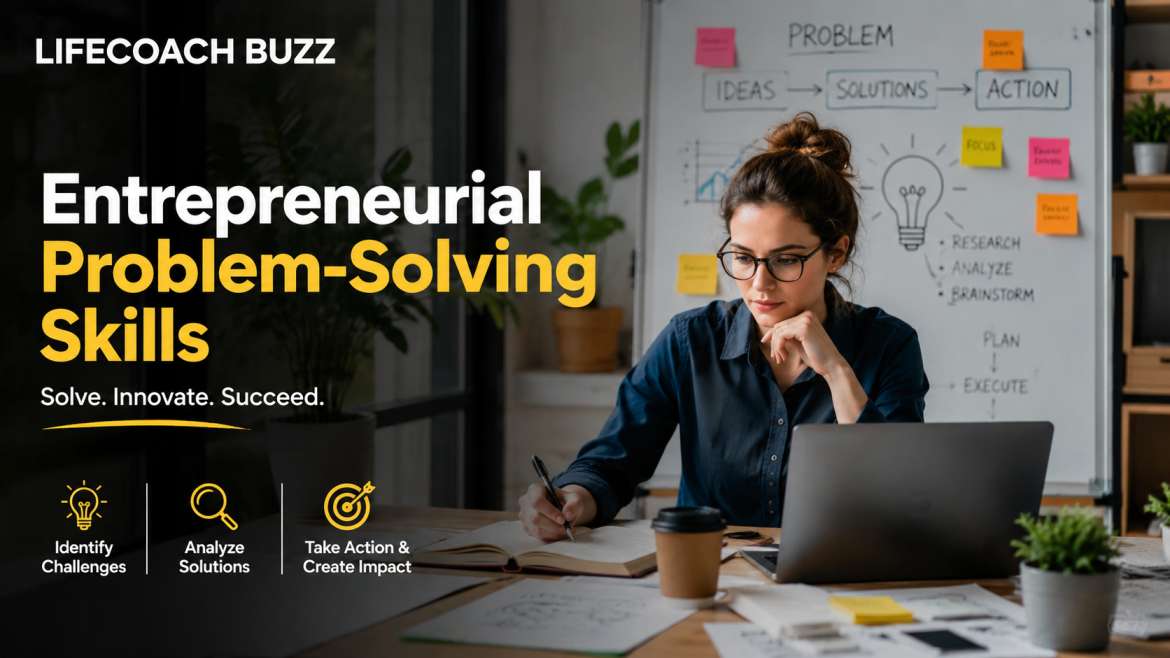
Solving problems is a skill you can practice. It requires cognitive flexibility in entrepreneurship. This means you can change your thinking when the situation changes. If Plan A does not work, you don't give up. You quickly pivot to Plan B.
Good problem solvers break big issues into tiny pieces. If you want to start a bakery but have no money, that is a big problem. A small piece of that problem is "How can I bake one cake and sell it to a neighbor?" Once you solve the tiny piece, you move to the next one. This step-by-step approach makes huge goals feel possible.
Also read :- Top Entrepreneur Habits That Drive Business Growth
6. Prioritize Action Over Perfection
Many people never start a business because they are waiting for the "perfect" moment. They want the perfect logo, the perfect website, and the perfect plan. This is a trap.
Entrepreneurs know that "done is better than perfect." They launch a simple version of their idea. This is often called a "minimum viable product." They put it in front of real people, get feedback, and then fix it. If you wait until everything is perfect, you will be too late. The market moves fast. You must move faster.
7. Develop Intense Focus & Commitment
Distraction is the enemy of growth. To succeed, you must have an intense focus. This means saying "no" to many good ideas so you can say "yes" to one great idea.
In the beginning, you might have ten different things you want to do. If you try to do all ten, you will fail at all of them. Pick one path and give it all your energy. Entrepreneurs stay committed even when the "newness" of the idea wears off and the hard work begins.
8. Build Resilience
Business is hard. You will face "no" from customers. You might lose money. You might have a product fail completely. This is where resilience in business failure comes in.
Resilience is the ability to bounce back. Instead of feeling like a failure, a resilient person asks: "What did I learn from this?" They treat failure like a science experiment. The experiment failed, but now they have data to make the next experiment better. You only truly fail when you stop trying.
9. Be Customer-Centric
A business without customers is just a hobby. To think like an entrepreneur, you must stop thinking about what you want and start thinking about what the customer needs.
Listen to people. What are they complaining about? What do they wish was easier? If you build something that truly helps people, money will follow. Successful founders spend more time talking to customers than they do looking at their own ideas.
10. Adaptability in the AI Era

We live in a time where technology changes every week. Adaptability in the AI era is now a requirement. Tools like artificial intelligence can help you work faster, write better code, or manage your time.
An entrepreneurial mind does not fear AI. It asks: "How can I use this tool to serve my customers better?" Being adaptable means you are willing to throw away old ways of working if a better way exists. Stay curious and keep testing new tools.
How to Take Action Today
Thinking is good, but doing is better. If you want to start thinking like an entrepreneur today, follow these simple steps:
Start Small
Do not try to build a billion-dollar company on day one. Find one small problem in your neighborhood or office and solve it.
Ask Questions
Whenever you see a business, ask yourself:
- "How do they make money?"
- "Who is their customer?"
- "How could they make this experience better?"
Write Down Ideas
Keep a notebook or a file on your phone. Every time you have an idea, write it down. Most of them will be bad, but that is okay. You are training your brain to look for opportunities.
Find a Mentor
Talk to someone who has already started a business. Listen to their stories of failure. You can learn from their mistakes so you don't have to make them yourself.
Employee Mindset vs. Entrepreneur Mindset
| Feature | Employee Mindset | Entrepreneur Mindset |
| View of Problems | Something to avoid or complain about. | An opportunity to create a solution. |
| Risk | Prefers safety and certainty. | Takes calculated risks for growth. |
| Learning | Learns what is needed for the job. | Constantly learns new skills (Growth Mindset). |
| Mistakes | Feels like a failure or a reason to quit. | Seen as a lesson and a way to improve. |
| Action | Waits for permission or a perfect plan. | Starts now and fixes things later. |
| Focus | Focuses on tasks and hours worked. | Focuses on results and customer value. |
Final Thoughts
Learning how to think like an entrepreneur is a journey. It does not happen overnight. It is a daily choice to be curious, stay brave, and keep going when things get difficult. Remember, the world is full of opportunities. Most people are just walking past them because they are looking for a safe path. If you can train your brain to see the potential in every problem, you will find success in whatever you do.
The most important step is the one you take right now. Do not wait for tomorrow. Look around you, find a problem, and start working on a solution. That is the true spirit of a founder.

.webp)